

What Substack Might have been
An early assessment of Sam Harris' closed Social Media Community Platform

As a long-time paid subscriber, I have been invited to participate in the beta test of Sam Harris’ new community platform. It is currently open only to subscribers, not the general public. Given that Harris has more than 800,000 subscribers, with estimates of up to 50,000 paid subscribers, the idea is more substantial or less silly than it might first sound.
A formal prediction from my writing desk is that others will follow. I don’t mean celebrity intellectuals or influencers creating Patreon channels, that is already happening, I mean distinct personality-based communities.
I am not here to promote Sam Harris’ new community platform, per se. Whether it is a good or bad idea, or how well it will work out and what it may achieve, all remain to be seen. It is too soon to tell.
But taking part so far, one cannot help but notice and reflect on the differences to other social media, especially what I have fondly and sadly come to consider Substack as, as the best of a bad bunch.
“Fondly” because Substack still carries traces of what many of us hoped the internet might become: longer-form writing, independent voices, reader-supported work, serious essays, niche intellectual communities, and some remaining space for thought that does not have to compress itself into pure feed behaviour.
“Sadly”, because those better qualities now sit inside the same incentive machinery that corrodes most platforms: attention capture, audience management, personal branding, public grievance, status play, algorithmic mood swings, and the conversion of thought into content. The frustrating thing is that there is much good here. Substack still contains serious writers, real inquiry, independent voices, and communities of genuine interest. But all of this is increasingly surrounded, diluted, and degraded by the predictable clown show of AI content creation, account-building hacks, performative engagement, mutual amplification games, and the same bad behaviours that deform every other social platform, especially when the algorithm appears to reward them.
The Blurb
Reading the “Begin Here” section, I felt a bit sad thinking about what Substack could have been / could never have been.
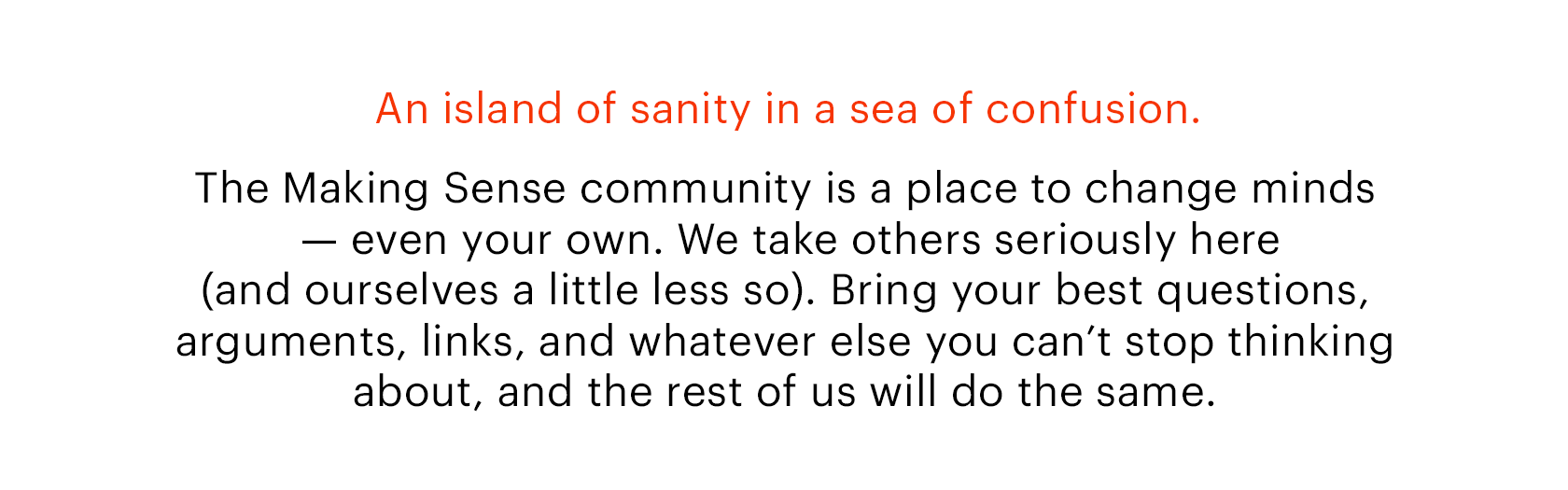
The boilerplate (embedded as an image above), reads:
“The Making Sense community is a place to change minds—even your own. We take others seriously here (and ourselves a little less so). Bring your best questions, arguments, links, and whatever else you can’t stop thinking about, and the rest of us will do the same.”
If only.
Whether Sam Harris and his team are able to fully realise that great intention only time will tell, but the chance of it producing a better result has to be improved by the framing of such an intention.
I could not help but consider the stark contrast of how one might frame Substack’s reality:
“The Substack community is a place to capture minds, preferably without changing your own. We take ourselves seriously here, and our subscribers as evidence that we should. Bring your best takes, arguments, links, grievances, screenshots, and whatever else you cannot stop packaging as insight, and the rest of us will do the same.”
Anonymity vs Transparency
For a start, real names on Harris’ closed platform are mandatory.
Why might this matter?
There is a serious argument that Twitter/X would not have failed social discourse so thoroughly if anonymity, masquerading, bots, sock puppets, and disposable identities had not been allowed to distort the basic conditions of conversation.
Twitter/X did not fail social discourse only because people were toxic or combative. It failed more so because anonymity and masquerading inevitably destroy the conditions under which discourse can be trusted in the first place.
Not only is X a failure of social discourse, but it is also a direct and virulent contributor to various aspects of poor mental health for the individuals who engage with it. As it happens, Sam Harris left X precisely for that reason in November 2022, and years later, regularly attests that doing so has been net positive for his mental health and mental bandwidth, and has not meaningfully diminished his currency of news and key headlines.
Once a platform permits speech and influence without identity or accountability, or permits apparent consensus without verified human authenticity, it ceases to function as a public square and becomes a theatre susceptible to farce and signal manipulation.
A real-name norm will not make a community virtuous in and of itself, but it will give the culture one of the basic preconditions for good-faith exchange: people must stand behind the words they speak, and the words spoken must belong to a real participant.
As much as we love a good pen-name or nom de guerre, anonymity is where duplicity, bad-faith engagement, and cowardice hide. Of course, we cannot say that all anonymity is corrupt or cowardly. There are real cases where anonymity protects truth-telling, whistleblowing, vulnerability, or personal safety. The problem is that anonymity also creates ideal cover for people who want the power of speech without the burden of authorship.
Rules of Engagement
Here are the rules of engagement community.samharris.org is leading with, and users are expected to abide by, at the time of writing this:
Engage in good faith. Assume the best of people you disagree with. Challenge ideas, not intentions.
Steelman before you criticize. Make sure you understand someone’s position before you argue against it. If you can’t articulate their view fairly, keep reading.
No outrage, no grandstanding. This isn’t the place for performative takes or scoring points. Say what you actually think.
Stay curious. You might be wrong. So might everyone else. Approach conversations as a chance to learn, not just to be heard.
Keep it civil. Disagree as sharply as the argument requires, but never get personal. Attack the idea, not the person. No insults.
No spam or self-promotion. Don’t use this community to sell something or grow your own platform.
Stay on topic. If your comment is about something different, consider creating a new post.
Respect the lurkers. Not everyone wants to post. Don’t pressure people to engage, and don’t call out members who prefer to listen.
AI is a tool, not a voice. Feel free to use these tools however you like to think, research, or edit, but what you share should represent your own thinking.
What is striking about these community guidelines is how basic they are, and how absent they are from social media in any real sense, because they are absent from the world. Good faith, steelmanning, curiosity, civility, no grandstanding, no spam, no self-promotion, no synthetic voice masquerading as authentic thought; None of this should feel radical and yet Substack is now almost typified by the routine violation of these norms. People argue before they understand, perform certainty for their audience, confuse disagreement with personal hostility, use the comment space as a visibility game, and increasingly launder AI-generated fluency as if it were their own earned or forged insights and prose.
My thoughts on…
Some of the points deserve to be dialled into, in more detail.
Point 2. Steelmanning.
The idea that all participants should understand someone’s position before they argue against it would be a game-changer. A healthier discourse culture would require participants to demonstrate that they understand a position before arguing against it. If that norm were meaningfully adopted, the volume of argument on most social platforms would fall dramatically, perhaps by a third or more, because so much comment traffic consists of people objecting to positions they have not actually understood.
But this also runs into a basic principle of social governance: do not create rules or laws that cannot be enforced. A platform cannot reliably police understanding. It can moderate insults, spam, threats, bots, impersonation, and obvious bad faith. It cannot reliably adjudicate whether someone has inwardly grasped the strongest version of another person’s claim.
Point 4. Curiosity.
Someone posted a poll to canvas responses from the audience, on a scale of 1 to 5, about how Curious they were.
When I see something like that, after years of being sniped at in the pvp social media arenas of the great unwashed, I feel like I am being entrapped.
My official answer to the poll was 5.
My actual answer was: Very. >5
But, I hasten to add, there is a highly persistent and pervasive misconception that curiosity or open-mindedness should equal tolerance of ideas that one has already transcended philosophically or intellectually. I don’t need to be open-minded about an easily debunked conspiracy theory, or say Scientology, or Mormonism. There are some ideas and theories we have already chewed through and classified fairly and accurately as junk food or dime-store candy, or poisonous.
Online or in-person, when someone floats some inane idea, and you aren’t interested in regressing into philosophical or intellectual kindergarten with them, the pithy reaction you get back is “oh! I thought you said you were curious or open-minded…” as if they are catching you out in some kind of hypocrisy gotcha.
I am super curious, insatiably curious about new frontiers, more sophisticated ideas, transcendent paradigms, more elegant theories, but not remotely interested in forcing myself to entertain banality for the sake of performative open-mindedness or performative curiosity.
Can we make that distinction?
Point 9. AI Authorship
I talk and write about this a lot, very stridently so, so I particularly love the way Harris’ team framed this:
AI is a tool, not a voice. Feel free to use these tools however you like to think, research, or edit, but what you share should represent your own thinking.
I believe writing reveals character. And therefore, posting AI or plagiarised content reveals a poverty of character. If you can’t use your own voice, rather say nothing. It is not as if we are short of content or opinion.
It is not that I am advocating rejecting these incredible tools like some kind of purist; I’m not writing with pen and paper or cranking out memoirs on a Hemingway typewriter. I use AI to do research, to parse complex ideas and to organise my own thoughts. But there are limits. Where is the line?
I am aware there is a blurry, moving line we are all still trying to find without losing who we are, but for all that, if we cannot use our own human voice, and disclaim which parts AI authored, what the fuck is the point of discourse?
Non-disclaimed AI writing both masks and betrays superficiality.
When AI writing is undisclosed, the reader is tricked into attributing fluency, structure, and apparent insight to the named human content creator. This masks a superficiality in the person posting the content who pretends a competence of thinking, expression and most critically an interiority they do not necessarily possess.
At the same time, undisclosed AI writing betrays superficiality in another way, in how the AI prose so predictably reveals a lack of pressure behind the copy-pasted words. The sentences resolve too perfectly, the argument carries no scar tissue, betraying how the would-be writer performs a quality of understanding they have not forged or alchemised in themselves.
I often say that we each make our choices, and some choices are made for us, below the waterline of our consciousness.
When I read AI writing, it looks like AI writing. It feels like something. It generates a feeling change within the field and something that I cannot control, pushes the work away, and no matter how much I try to engage with the essence, the ‘synthetica’ of it harms the flow and kills my authentic engagement. The potential connection with whatever meaning is being shared is impinged.
What I can choose is how I have decided to not blame myself for having a healthy aversion to such synthentica. To borrow from Jiddu Krishnamurti, “It can be no measure of good health to be well adjusted to synthetic AI-generated content.“
If you write this way, you do you, but find the courtesy or the courage to disclaim it and have the sense to realise that there is a species of discernment that sees it as something less than it could be, and you something less than you could be.
That’s all for now
It’s early days there, and our modern reality has left me cynical, so I’m not holding my breath. I’ll keep sharing what I encounter.
Yes, that's a very productive use of AI. We cannot shun it away. That is a mistake that we will pay for in the future.
I believe it would be worth mentioning this to the sam harris people. See what may come of it. If nothing, then an effort can be made to create this regardless. It is well worth the effort and is much needed. The neutral moderator is essential for transcending duality and up there is where we have to see if we want to find our way out of the storm.
really appriciate your article. I did a restack with my perspective on the topic.