

Christ for Atheists
The Perennial Invitation to Greatness of Spirit Without Believing in a Single God

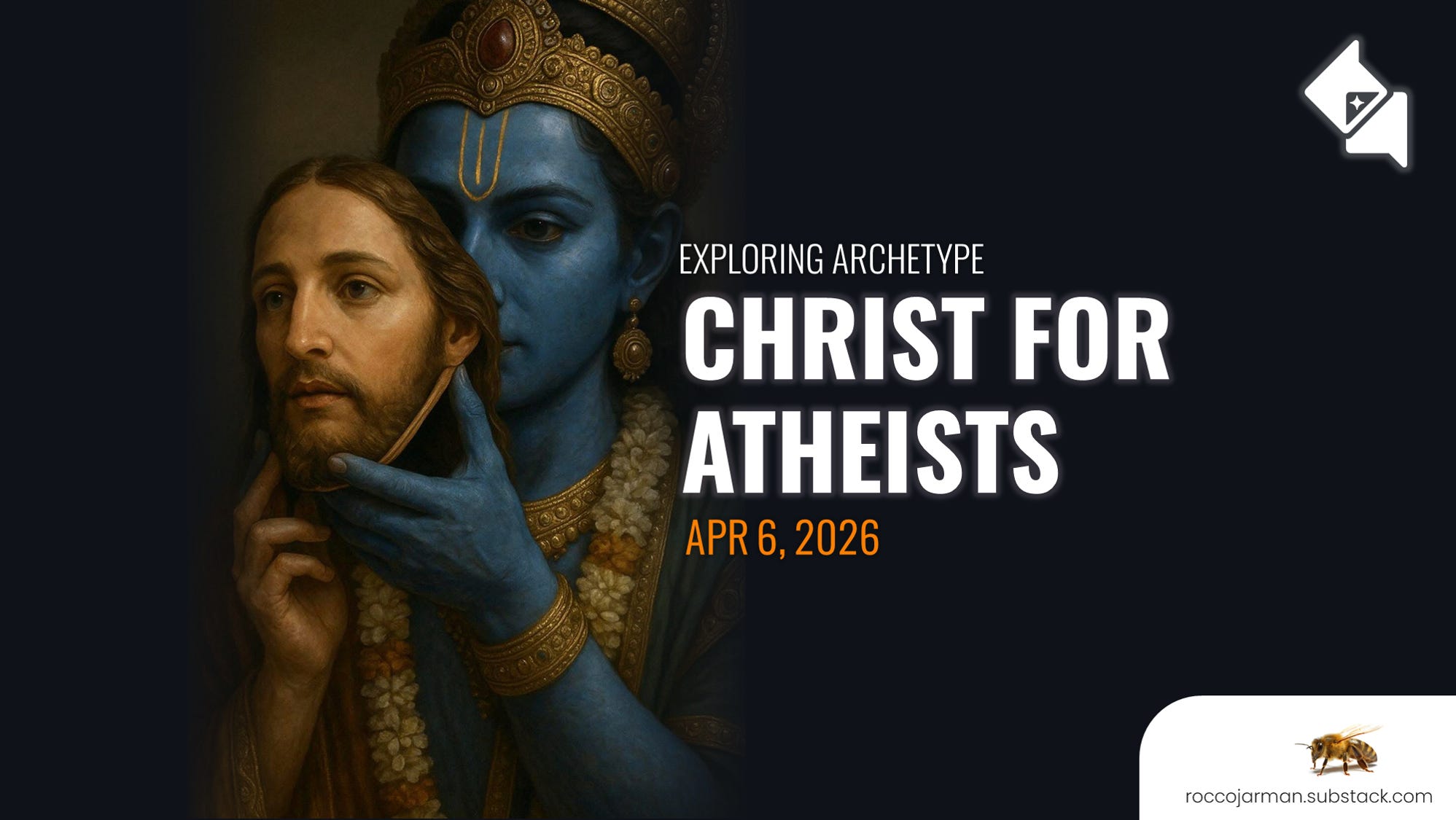
This post explores how Mythos functions as a cognitive tool for meaning-making, independent of religion or belief in God. It examines Christ, Buddha, Chiron, and Mandela as archetypal models, showing how they offer guidance without requiring faith. Rejecting religion outright is too simplistic; we must reclaim and refine the wisdom within it, ensuring that meaning, leadership, and self-actualisation are consciously shaped rather than lost to nihilism or fundamentalism.
Remember, you can listen to these posts like podcast episodes by downloading the iOS app. In fact, would thinking of this as a podcast episode change the way you engage with it?
As always, this post is not just content; it is an invitation for you to slow down for a moment, to compartmentalise a bit of ‘me’ time for yourself, and to not allow the momentum of everything else to intrude on this moment. Presence, discernment and intentionality are how we choose a life by design, instead of living a life by default.

“It takes mindfulness to come to a human life. And then above that, it takes mindfulness and virtue to come to a fortunate human life.”
Guy Burgs
Stories compress wisdom into digestible, retainable, and transferable forms. Societies organise around shared narratives, whether they acknowledge it or not. Mythos helps individuals frame their struggles, orient their decisions, and integrate meaning into action. Mythos is never intended to serve as a truth claim; it is a cognitive device that helps the mind and the psyche align and cohere. Even if we discard belief, we do not discard function.
We do not believe in Mythos because it is literally true; we use it because of how effectively it works on the human psyche.
Some people believe that consciousness is some kind of academic illusion, that values are incidental byproducts of evolution, and that morality is a social construct. Regardless, we all still live inside emergent mythic frameworks that shape our decisions. It is more sensible to actively participate in parsing and integrating these mythic frameworks consciously rather than pretending they do not exist.
Archetypes are universal, timeless patterns or themes that appear across cultures, stories, and human experiences. They represent fundamental aspects of being human, that is to say our fears, desires, motivations, and behaviours.
They are not just abstract roles such as Warrior or Hero. The Marvel Cinematic Universe, for example, exposed a wider public to comic book archetypes that had informed the ethos and mindset of millions of younger readers for generations. These characters become cultural touchstones influencing how people think about leadership, justice, identity, chivalry and sacrifice.
Any enduring story, where the tropes and characters are common to many people, can be said to be part of the cultural mythology. What value and meaning can the archetype of Christ represent for an atheist?
This entire project can be explored within the bounds of Mythos, without requiring belief in any literal deity. One does not have to believe in the Marvel Cinematic Universe to be inspired in a very real sense by the selfless and uncompromising ethical example of a fictional Captain America in the story. No one needed to believe Dostoyevsky’s characters were real to draw meaning and value from those stories.
Similarly, to get value from the Judeo-Christian mythos, we do not need to smuggle in God as the fulcrum of sense-making and meaning. The mistake of the hard atheist or the reductionist materialist when disregarding religion is to throw out the baby of cognitive architecture along with the metaphysical bathwater. Religion, at its worst, makes unfalsifiable truth claims about the supernatural. But at its best, it functions as a mythopoetic repository of human wisdom, encoded in metaphor and story, very useful so long as we can remain unconfused about its status as metaphor and story.
If we fail to translate theological ideas into metaphor, we leave their allegorical relevance entirely in the hands of ‘believers’. The state of politics in America and the world over the last decade is a showcase of what happens when ideological fundamentalism is weaponised against humanity. We do not typically regard what is happening in America and its cultural hegemony as fundamentalism because it does not look like anything so obviously recognisable as radical Islamic fundamentalism. But, if we are being intellectually honest with ourselves, what else would we call Liberal fundamentalism or Conservative fundamentalism, or Libertarian fundamentalism or Woke fundamentalism or Trans fundamentalism? And let us not forget Christian fundamentalism. Each of these describes an ideological contagion that defines its own parameters of reality, lives inside a truth claim of what is moral and right, and typecasts any disagreement as heretical and all non-believers as the moral enemy. The evident problem is fundamentalism, and the most recognisable symptom of this contagion is the suffix ‘-ism’.
The problem with such ideologies, especially religion, is that it insists its stories are literal and it tries to enforce its dogma on its neighbours, who invariably engage with reality differently.
That said, if we reject religion outright without reclaiming the Mythos and distilling the wisdom from that, we risk amputating something vital.
Nietzsche declared that God was dead. All of Nietzsche’s work is widely misunderstood, and this statement was particularly sensationalised, but he did not intend it that way; he said it as a cautionary observation. He observed that religion had provided the coherence, moral structure, and existential orientation that bound societies together. In its absence, either something else would necessarily have to fill the void, or humanity would drift into nihilism, fragmentation, or ideological possession.
What Nietzsche did not fully recognise is that religion had not created this function in any sense; it had very effectively co-opted it. Shared Mythos has always been the real connective tissue of culture. This is such a reliable indicator of our current societal fracture.
Mythos should not be seen as a Trojan Horse for theology; it is more like a ring-fence in which to contain fictions so that we never stand the risk of being confused by what is metaphor and what is literal. This means that the more inclined you might feel that religion is bullshit, the more necessary Mythos becomes as the way in which we reduce its ontological claims to allegorical metaphor.
Mythos is how we bind people together without dogma and how we encode and refine wisdom without faith.
Mythos is the collective word for the realm of symbolic storytelling of a culture or a society and has always been humanity’s most potent tool for sense-making for its own orientation and meaning-making. Not all human beings are configured to derive sufficient meaning-making and orientation from the cold comfort of philosophical principles; we need a medium in which to encode meaning. We need stories, and what is more, we need shared stories, shared ideas, shared tropes and shared archetypes. These help us parse emergent reality and adapt to change.
A simple example is the story of the underdog archetype who refuses to quit, which we encounter in films, in sport, or in business. The story and what it does to inform us and inspire us cannot be achieved by a philosophical argument about perseverance alone. The story orients behaviour in the same direction as the philosophical principle, but people recognise and relate to the pattern, place themselves inside it, and act accordingly. In a sense, we can say that the philosophy is coherent to the human mind, but the story is resonant with the human soul. Children integrate social adaptive behaviour more readily through stories than through rules.
What is more, the story itself does not need to be historically or metaphysically true for it to contain something of ultimate relevance. The value of it lies in the distilled wisdom, the archetypal resonance, and the navigational clarity it offers to the human experience.
The essence of that wisdom, that is to say, what gives it force, weight, and the power to orient our lives, is not something that can be grasped purely as an intellectual proposition. Meaning has to be understood as something other than the product of the pure reasoning mind; it is a phenomenon of the psyche and requires narrative and archetypal context of relationship with nature and the elements, with the cosmos and something conceivably even beyond it.
Our minds can go on forever where our hearts cannot follow. This is a fundamental truth of being human. For the mind to cohere as a self, the soul must be present. For the soul to cohere as a self, there must be meaning. (Until we build that capacity for soul, that function is served by the ego.)
We tend to assume that Mythos is a primitive scaffolding that ought to be discarded as soon as we build the arch of Logos, but depth psychology says that this is a mistake. Mythos is not just a stepping stone to Logos. At certain junctures of the human journey, Mythos is the only stepping stone available. If Logos is the arch and the pillars of the bridge, then Mythos is the span between them and specifically that which beckons us across it. Meaning is the very thing that allows us to traverse the abyss.
The path of knowledge has always unfolded like this. The prototype of science was alchemy, magic, and divination. The prototype of rationality was superstition distilled through lived experience. We have never simply arrived at truth; we have always titrated our way toward it. And we always will. We have never, and will never, can never reach directly for ‘ultimate truth’ with perfect fidelity. We can only reach there incrementally, the chariot of our truth and reason drawn by the horses of imagination and the mules of stubborn belief.
The pure, undiluted essence of truth would be overwhelming to the mind and psyche alike. We must iterate our way toward becoming, toward transcendence, one stepping stone at a time, one mile of our pilgrimage at a time, crossing one bridge at a time.
Christ Without God
Think of Christ in the archetypal sense in the same way we mention a Buddha, but without the metaphysics of reincarnation, in other words, not the same ascended ‘Self’ recurring across lives, but different ordinary human selves, across time, tuning into and relating to the same essential signal. It is, of course, not about a literal person that did or did not exist but about the archetypal pattern that definitely does.
It does not matter whether Jesus literally existed or not. I happen to think that whoever may have existed is questionable and completely unverifiable, and far less tangible than the example captured in the mythos of him. Surely, what is most salient is the archetype that his story represents when stripped of dogma, fantastical claims, and the weight of institutional control. We need to appreciate that the gospels were written decades after the events they describe, in Greek, by unknown authors drawing on oral traditions, and later selectively compiled and translated by early church councils from among many competing accounts.
When we read To Kill a Mockingbird, we do not spend any time worrying about whether Atticus Finch was real or not to draw meaning-making and sense-making from the example of his integrity, compassion and courage in the face of injustice, and his deep love for his children. One can aspire to the character of Atticus Finch without needing him to have been a real person.
The least salient question is whether Christ was real in the historical sense. Far more relevant is whether the ideal ‘he’ embodied is real enough to shape lives, real enough to carve out a higher path in the chaos of existence we find ourselves quagmired in.
The ideal of Christ, at its core, is simple:
Orientation toward truth, even when it carries personal cost
Compassion expressed in action, not sentiment
Integrity under pressure, without collapse or posturing
Willingness to bear consequences rather than betray what one knows to be true
Refusal to degrade others, even in conflict
Capacity to forgive without abandoning discernment
Resistance to resentment in the face of suffering
Alignment of conduct with what is right, rather than what is expedient
Care that extends beyond tribe, status, or reciprocity
Commitment to live these values consistently, not selectively
This is the refined Golden Rule in practice:
Not just do unto others as you would have done unto you, but what would I want of this moment if the shoe were wholly on the other foot? And what does the moment want of me, without requiring that I obliterate myself for the sake of others? What does Love look like right now? What is most beautiful to my soul?
Sacrifice, yes. But sacrifice for what? Do not sacrifice your life for the world. Sacrifice your life for your own true becoming and fulfilment, in covenant with the inheritance of the past and the legacy of the future.

The Next Phase of Human Development
“Joy to the world. The Lord hath come.”
Let the once be enough.
That is all.
Just let the once be enough. Pick up the essence of the signal, just as we ought to pick up the essence of the Buddha’s path, again, not the superstitions or cultural baggage, but the living signal of it.
We have already tried:
Just Love: Surrender and Compassion.
Just Wisdom: Virtue and Insight.
Now, let us try:
Maturity and Understanding: Choice and Leadership.
Let me surrender a portion of my Mind’s workings to the path of the Buddha Archetype.
Let me surrender a portion of my Psyche’s narrative to the path of the Christ Archetype.
This should be no different to a person with a life-long digestive ailment saying “Let me surrender a portion of my truth to the Wounded Healer Archetype: Let how I frame my experience and choose my behaviour be informed by the example of Chiron.”
Chiron was the Centaur in Greek mythology who was wounded by a poisoned arrow, an injury that could not heal, yet instead of succumbing to suffering, he transformed his pain into a gift, becoming the archetype of The Wounded Healer.
It should be no different to a person during a difficult divorce saying, “Let me find refuge in the example of the Reconciler Archetype.”
They are saying, “Let how I respond to unkindness and vitriol be informed by the example of Nelson Mandela.”
Nelson Mandela was a South African freedom fighter who had been imprisoned for 27 years under a brutal regime, yet upon his release, he chose not revenge and retribution, but reconciliation. No one thinks of Mandela as naive. It is appreciated that he did not pretend that the injustice had not occurred. Instead, he framed justice as a means of healing rather than retaliation.
Each such archetypal character that inspires does so because they do not only endure limits and obstacles, but also because they accept them as essential to the path of becoming.
The Chiron Archetype is not the healer despite his wound; he is the healer because of it. Having mapped his wounds, his suffering defined him and he became the greatest healer of that age.
The Mandela Archetype is not a leader despite imprisonment, but because he allowed it to temper him, to deepen his understanding of human nature, and to clarify the kind of world he sought to build. He mapped his wound.
The Buddha Archetype does not awaken in spite of suffering, but through deep engagement with it, seeing its structure, understanding its nature, and ultimately transcending attachment to it.
Similarly, the Christ Archetype does not endorse passive suffering, nor is he merely a symbol of sacrifice, but rather, he represents integrity in the face of power, a radical invitation to actualisation, and a willingness to walk the path regardless of consequence.
Let me surrender a portion of Mind to the path of the Buddha Archetype. Mindfulness and discernment of self and the illusory nature of thoughts and feelings are never going to not serve us.
Let me surrender a portion of Psyche to the path of the Christ Archetype. Invitational leadership, magnanimity and wisdom that transcends traditional rigid thinking are never not going to benefit us.
Just ensure one thing: we need to ensure that what we long for most deeply is ultimately the fulfilment of our own story. We did not come here to walk wholly in the footsteps of another.
“Do not seek to follow in the footsteps of the wise; seek what they sought.”
Matsuo Bashō
The story of Christ literally returning is precisely where that project loses its relevance and alignment to the greater human project, where it asks us to wait for a redeemer rather than to actualise and redeem our own ticket to ride.
The notion of a literal return of Christ makes the project of human actualisation redundant. This is not what we want. If we are merely waiting for someone else to set the world right, then we have already forfeited the most vital dimension of our own agency.
If it is true that some souls are so wretched that they can only be saved by redemption, then let them seek redemption. But we are not so wretched, and we are not so powerless. And more than that, we are capable of growing our potential and agency beyond what we have imagined.
That is the metric we should be tracking—our Sovereignty Quotient: the measure of our agency, responsibility, and capacity to engage with life in a meaningful way. This quotient can be expanded and deepened, and it can also be lost and atrophied, through the quality of our choices, or lack thereof.

Free Will in a System of Fate
Fate is a word to describe the world and all its moving parts in the state we find them in every moment we call Now. Our current fate is the result of all those parts interacting with each other in the past to produce the current unchangeable state we encounter in the present. Therefore, Fate is not exactly a rigid determinism, but rather the set of prevailing conditions and constraints into which we are born, the starting point, the limitations, and the shaping forces that are beyond our immediate control. Fate is the inertia of the past, the unseen hands of ancestry, biology, and circumstance, the currents that we are already caught within before we are even aware of movement. By that same logic, how we interact with the present moment, we can shape the future we will encounter tomorrow. We do this all the time.
In time-travel movies, there is always a major caution about affecting the past, which can cause significant changes to the present. Surely, then, affecting the present can cause significant changes to our future. So Fate then, is the hand we are dealt, but it is not the end of the story. Fate is the emergent field of play that we inherit from the previous moment, placing some but not a total constraint on how we respond from here.
In this framing, Free Will is not the wholesale ability to reject Fate and defy reality altogether, but more the ability to work within its constraints, to navigate it, to bend it, to push against its boundaries, and in some cases, to transcend it entirely.
Fate is the proving ground of agency.
It is true that we have only limited Free Will; limited wriggle room to defy our nature, our conditioning, and our fate. But even within those limits, expansion is possible. The circumference of our agency can be pushed outward.
And beyond the individual, we hold the power to shape the conditions that shape us. Governance protocols, traditions, and cultural practices are not background elements of the human experience. These are the forces and levers by which human wisdom is institutionalised, by which we create the conditions for actualisation, by which we ensure that free will is not only exercised but intentionally stewarded.
Legacy: Covenant Without a God
You can be as atheist as you like and still participate meaningfully in a covenant with Legacy and Inheritance.
“Life is a current, flowing through all that has come before you and all that will follow. You are not separate from it; you are a vessel, a conduit through which energy moves. The struggles, wisdom, and love of those before you are carried in the very breath you take, and in turn, the choices you make ripple forward, shaping the world yet to come. The past is not behind you, nor is the future ahead; it is all here, now, in the way you meet this moment. Will you let that current ebb and weaken, or will you step fully into the stream, bringing clarity, strength, and presence to all that passes through you?”
Each one of us can contribute toward a potential we might never personally realise. We can plant trees whose fruit you will never taste, and in whose shade we will never get to sit, and paradoxically, we can derive a truly great sense of meaning and fulfilment from that pursuit. We can derive a sense of greatness from such devotion.
  Do your part. That is all.

  If it is a great part,
  do it with grace.

  If it is a small part,
  do it with greatness.
This is the most human and real connection to Meaning, the one that even the most ardent atheist cannot deny. When we love and live for our children, we are already living for something greater than ourselves. That, in essence, is a covenant. We make this covenant with our children to settle the cost of their becoming through our efforts, not begrudgingly, but in a way we are inimitably proud of.
When we give ourselves fully to raising, protecting, and guiding our children, we are engaging in something larger than personal survival—we are binding ourselves to a lineage of meaning that stretches beyond us. To honour what came before is to discern and preserve the roots that sustain so that we can wisely trim the ones that no longer serve. What we inherit is what we pass forward. A covenant with Legacy is a covenant with Ancestry because we stand at the very intersection of both. How could it be otherwise?
To live for something bigger than yourself and to believe in something greater than yourself need mean nothing more than this.
Christianity, as an institution, cannot survive its own export to mature modernity, but an essence of it can and should be distilled. A vital signal within its sanctimonious drone can be isolated and merged with the distilled essence of Buddhism and blended discerningly with the essence of living wisdom of every other worthy tradition.
Because what must survive is the signal. The form, the hierarchical institution and its dogmas are not essential to that requirement. Only the meaning and sense of it, which was always meant to be carried forward as we define our own truth in relationship with emergent reality.
What a trip!
Please let me know how this landed for you in the comments section!
Until next time,
Rocco
p.s. I leave you with a quote from Guy Burgs. What a gem. Listen to the Spotify link I shared below; you can thank me later.
  ”When you came here
  You came here with a sense of awe and wonder,
  dying to just see what it’s about
  —what would it be like?
  To be down there?
  To be part of it?

  And you came here with a sense of wonder
  And somehow the wonder of it wasn’t enough
  And we stopped wondering
  and started to wonder about ourselves
  And in your wondering about yourself
  You forgot what you came here for,
  what you came to be a part of.”

Guy Burgs
I am an awake Christian but greatly enjoyed all that you communicated, It is really good for those who do not find my way useful. I thank you for this message. It is lovely.
You’re killing it my brother. I’m reading the Nag Hammadi Scriptures. Jesus’s teachings are so important.